Why Panic Attacks Keep Happening (And How to Stop the Cycle)
One of the most confusing aspects of panic attacks is that they often seem to return without warning.
Many people experience their first panic attack during a stressful moment and assume it was a one-time event. Yet weeks or months later, another panic attack appears. And then another. This leads to a question many people ask: Why do panic attacks keep happening?
The answer often lies in how the nervous system learns patterns of threat and safety.
Once the body has experienced panic, it can become highly sensitive to the physical sensations associated with it.
In other words, the nervous system begins to recognize certain internal sensations as potential danger signals.
Key takeaways
• Panic attacks often repeat because the brain learns to associate certain sensations or situations with danger.
• Fear of having another panic attack can increase hyper-vigilance and sensitivity to bodily sensations.
• This creates what is known as the panic cycle, where fear reinforces physical symptoms.
• The more the nervous system interprets sensations as threatening, the more easily panic can be triggered.
• Understanding and interrupting this cycle is an important step toward reducing recurrent panic attacks.
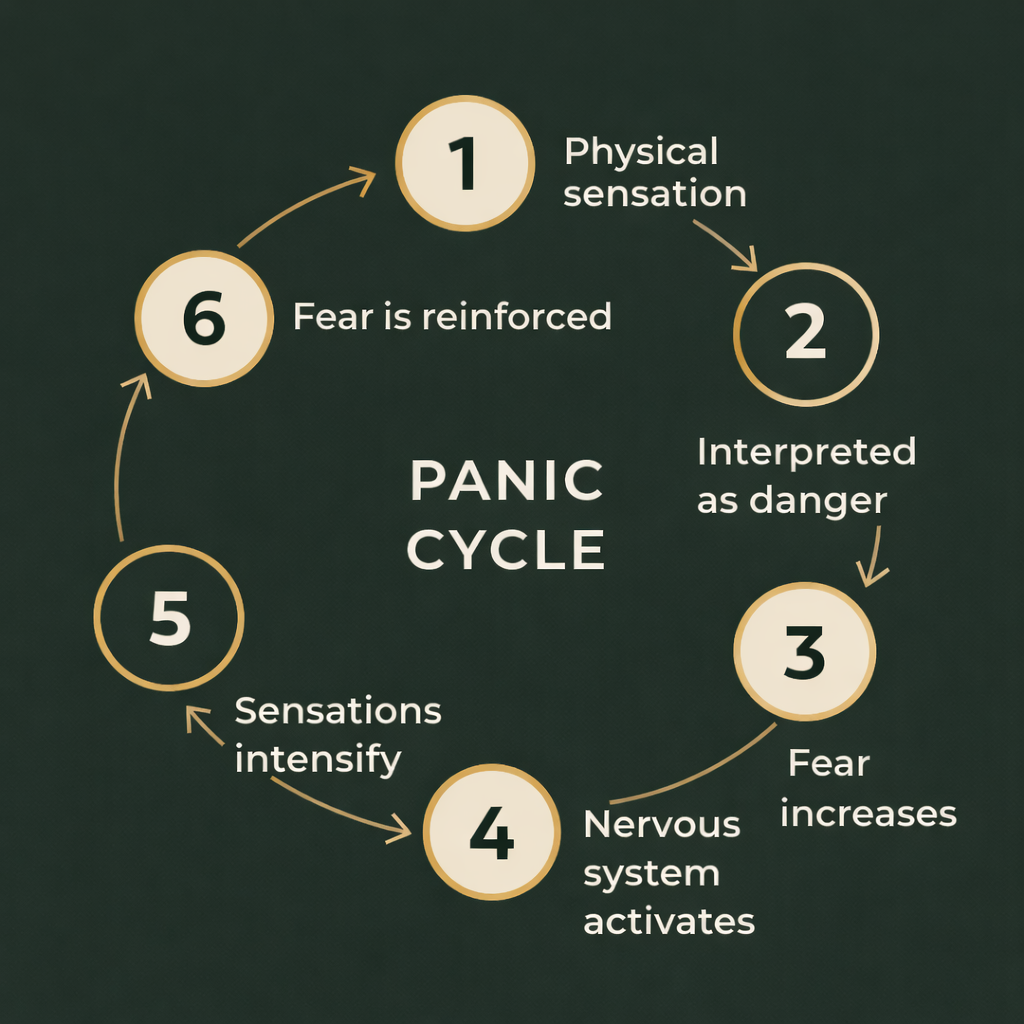
Panic attacks often repeat because the brain begins to associate normal bodily sensations with danger, creating a self-reinforcing panic cycle.
in this article
• Why panic attacks often repeat
• The panic cycle explained
• How fear reinforces symptoms
• Why understanding the cycle matters
• How the nervous system can learn to respond differently
The Panic Cycle: How It Develops
Panic attacks are often maintained by a pattern known as the panic cycle.
The cycle usually unfolds in several steps:
•A physical sensation appears (for example a faster heartbeat).
•The sensation is interpreted as dangerous.
•Fear increases.
•The nervous system activates more strongly.
•The physical sensations intensify.
•The intensified sensations confirm the fear.
•This loop can happen extremely quickly.
By the time a person consciously realizes what is happening, the body may already be in a full panic response.
Understanding this cycle is important because panic attacks are rarely random. They usually follow a predictable nervous system pattern.
If you would like to understand more about what is happening in your body during a panic episode, you may find it helpful to read what a panic attack actually is and how the body produces these symptoms.
Why the Brain Keeps Triggering Panic
The brain’s primary job is survival.
A small structure in the brain called the amygdala plays a central role in detecting possible threats. When it senses danger, it activates the body’s fight-or-flight response.
If a panic attack has occurred before, the brain may begin to associate certain bodily sensations with danger.
For example:
•a change in breathing
•a faster heartbeat
•dizziness
•internal tension
Once those sensations are interpreted as a threat, the nervous system can activate the same survival response again.
This is one reason panic attacks can feel as if they come “out of nowhere.” In reality, the brain is reacting to signals that it has learned to interpret as danger.
The Role of Fear of the Symptoms
Another factor that keeps panic attacks repeating is fear of the sensations themselves. After one or two panic attacks, many people become highly aware of their body. They begin scanning for any sign that another attack might start:
•checking their heartbeat
•noticing every small change in breathing
•worrying about dizziness or light-headedness
This heightened attention can make normal bodily sensations feel threatening. Ironically, the fear of panic can become one of the strongest triggers for panic itself.
Anticipatory Anxiety
Many people who experience recurrent panic attacks develop something called anticipatory anxiety.This is the fear that another panic attack might happen. Anticipatory anxiety can lead to avoiding situations where previous panic attacks occurred, such as:
•driving
•social situations
•travelling
•shopping centres
•crowded places
•public transport
Over time, the nervous system can become increasingly sensitive as life begins to revolve around avoiding the next panic episode.
Why Understanding the Nervous System Matters
One of the most important turning points for many people is learning how panic actually works in the body.
Panic is not a sign that something is broken in you. It is a learned nervous system pattern. The brain has become highly efficient at activating the threat response, even when the danger is misinterpreted.
Once this pattern is understood, the process of change can begin.
Can the Panic Cycle Be Stopped?
Yes.
Because panic attacks are driven by learned patterns in the nervous system, those patterns can also be retrained.
In my work with individuals experiencing recurrent panic attacks, an important shift happens when people stop fighting the sensations and begin understanding them. Instead of interpreting the body’s signals as danger, the nervous system gradually learns that the sensations themselves are safe.
This process often involves:
•reducing fear of bodily sensations
•understanding how panic escalates
•retraining the nervous system response
•rebuilding confidence in previously avoided situations
Over time, the brain learns that the alarm does not need to activate so strongly.
The Path Toward Breaking the Panic Cycle
Breaking the panic cycle usually requires more than simply trying to calm down in the moment.
It involves working with the deeper patterns that keep the nervous system in a state of heightened alertness.
When these patterns are addressed correctly, many people find that:
•panic attacks become less frequent
•the intensity of symptoms decreases
•confidence gradually returns
•life becomes less restricted by fear
This is not about suppressing anxiety. It is about helping the nervous system learn a different response.
When a panic attack begins, knowing how to respond in the moment can help reduce its intensity. You may find it helpful to read how to stop a panic attack when it starts.
Explore the panic cycle recovery program
If you would like to understand how this work is structured in more depth, you can explore the Online Panic Attack Treatment Program, where each session is designed to interrupt the panic cycle and retrain the nervous system.
Ready to Break the Panic Cycle?
If you have been experiencing recurrent panic attacks and would like professional guidance, you can apply for a consultation to explore whether this therapeutic approach may be appropriate for you.
During the consultation we can discuss your experience, how panic attacks are affecting your life, and whether this work may help you move toward greater calm, stability, and freedom.